Sunday, 10 March 2019
Glimpses in the dark
My favourite lens is my 100mm f/2.8. It suits the way I see, a bit shortsightedly, focusing on an interesting small detail, with everything else fading off into the background.
I spent a happy couple of hours at the Ulster Folk Museum yesterday using it to pick out little details in the old houses - slivers of china or fabric lit by sunbeams in the dark rooms, reflections in wavy picture glass, shadows cast on cracked plaster.
I wanted to create a mood that was secretive and compelling, with hints of stories unfolding from the shadows. It was a good technical challenge too, working with what may look like pure black, but is really shades of darkness. I wish I had time to write the stories now, but they'll wait a little longer.
Sunday, 17 February 2019
Safe
My workhouse obsession has been in full swing for a couple of years. It was sparked by the discovery that some of my ancestors in north Fermanagh had survived the Famine years of the 1840s only by entering the workhouse at Lowtherstown, now Irvinestown. Seeing their names and the descriptions of their pitiful circumstances in the workhouse records was a moving experience, and it set me off on a quest to discover more about their stories.
The workhouse buildings at Irvinestown are long gone, but Bawnboy, County Cavan, built to the same plan, like all the Irish workhouses, made a fitting substitute. You can read more about my first visit to Bawnboy here - it was another cathartic experience. I read all round the subject of the famine and the workhouse. My most helpful guides were John O'Connor's 'The Workhouses of Ireland', Breege McCusker's 'Lowtherstown Workhouse' and the recently published 'Atlas of the Great Irish Famine'. I travelled to the Irish Workhouse Centre in Portumna, County Galway, where Steve Dolan answered every question I could think of and showed me round another incarnation of the building which Margaret, James, Catherine, Irvine and Thomas Elliott entered in 1848.
As I worked my way round the topic and visited the dreadfully atmospheric workhouse buildings, I decided that an audio-visual piece based on my own family's Famine story would be a good response to what I'd discovered.
I was clear from the start that I didn't want to make a didactic piece, communicating historical information in a dry way, but a personal story, expressing the feelings of a real and relatable human being.
I chose Catherine, my great-great-grandfather James's little sister, as the focus of the work. To me, she became Cate, and I was delighted to find, when I came upon her details in someone else's family tree, that she was called this in real life.
I had a large portfolio of workhouse images I'd created at Bawnboy and Portumna. Now I needed Cate herself. Finding a famine-thin eight-year-old model was obviously out of the question, so I decided to focus on Cate as a woman in her twenties, thinking back to her experiences as a child. My model Hopewell personified the Cate of my imagination perfectly, with facial expressions and expressive gestures to communicate every moment of her journey. With her bare face, hair pulled back and handmade antique high-necked blouse, she became a thoughtful and damaged young woman from 1864.
Many of my workhouse photographs featured windows, as elegantly decayed architectural features and symbols of both imprisonment and escape. I couldn't believe my good fortune in locating, for Hopewell's "Cate" shoot, an old six-paned window which echoed strongly those of the workhouses. This became a key pivot point in the piece, with Cate shown first sitting outside the window, but moving behind it as the story recounts her admittance to the workhouse, her face partly obscured now by its bars. I structured a narrative that moved to and fro between Cate as a 24-year-old and the workhouse of her childhood, shown now as a near-derelict building. This was going to involve considerable suspension of disbelief on the part of the viewers, but I hoped that it would be effective.
My script was structured round Cate's experiences, told simply and clearly. My voice actress, Rosie, conveyed her words with total integrity, bringing them to life in a way that made me forget it was actually me who'd written them.
To provide contrast, I also included the words of the Matron of the workhouse, the visiting minister, the workhouse inspector Dr Denis Phelan (these words are taken from his real report into conditions at Lowtherstown), and an anonymous local man. Helpful friends and colleagues read these parts for me, populating the piece and lending it further authenticity.
Early in the process, I composed a simple lullaby for the Elliott family....
Safe, safe in my heart
I'll keep you safe in my heart
Stay near or go far, wherever you are
I'll keep you safe in my heart
As the script emerged, I decided to use the song at two key points in the drama: the moment when Margaret was separated from her children on admission to the workhouse (Charles Kickham's novel of 1869, 'Sally Cavanagh' helped me with this scene), and the tender moment near the end when Cate reveals her own current circumstances.
I composed all the music for the piece myself. I spent some time developing a palette of sounds to create the mood I wanted, with instruments such as a bouzouki, lute, cor anglais, flute, piano, folk percussion instruments and double bass. The style I chose is more contemporary than those of my other pieces, with no attempt to recreate the sounds of the nineteenth century apart from the presence of the simple lullaby. There's a recurring idea of a smear or glissando, referring to Irish traditional music but also aiming to cause a sense of disquiet.
The opening notes of the lullaby, 'Safe, safe in my heart...' became a motif which reappeared frequently in the score, always referencing the idea of keeping a child safe from harm. I also composed a theme for the workhouse itself: this can be heard for the first time when the matron starts to read the list of names of those admitted on 22 November 1848. (The 67 admissions she mentions for that date is an accurate figure.)
As well as the ubiquitous windows, a couple of other ideas emerged as visual themes within the piece. Flowers appear at significant moments. A cross transforms back into a broken workhouse window.
'Safe' has been a labour of love. I hope that it conveys something of the desperation and tragedy that these people experienced, something of the possibility of redemption and the long shadow cast over everything that came later. I suspect it's not my last piece of work on the subject.
Click on the image below to see the finished piece on Vimeo.
Sunday, 10 February 2019
Shoreline
It's cold. My default weekend outfit is an Aran poloneck, jeans and boots. My fingers don't really want to be outside, and I have a pair of outdoor photography gloves sitting in my Amazon basket, though frugality is procrastinating the actual purchase.
But this weekend it's spirit-liftingly bright and the better half of the year seems finally within sight. Yesterday I was at work till early afternoon, but the camera was in the boot of the car, waiting for a quick getaway to the beach.
I chose Millisle, gateway to a Peninsula circuit. The tide was almost fully in, and the shots I'd envisaged weren't going to happen. But there's always something beautiful to photograph, and my eye was drawn to the patterns on the sand at the edge of the water, where waves and sun combined in elegant sculpted textures.
I took a series of almost abstract shots in gentle focus, until my fingers started expressing too much displeasure at the temperature. Time to click the button on my Amazon cart.
Sunday, 16 September 2018
Pale seaside
Sometimes when I go out with my camera I know exactly what it is that I want to shoot. And most of my best images probably result from careful planning and research, though there's often a little happy coincidence in the mix as well.
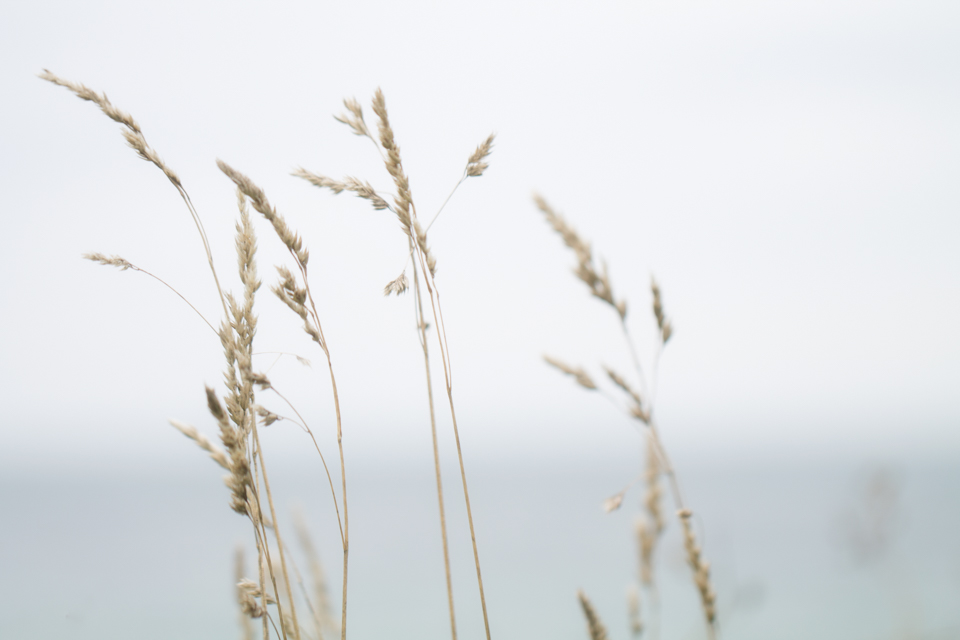
But sometimes it's nice just to go out and see what appeals to my eye. Yesterday was a day like that. It was a dry, dull September afternoon and I felt like walking on the beach to clear my head. I did my customary round-the-peninsula drive. The seas and skies weren't looking particularly photogenic except in the most minimalist of ways. What drew my eye instead were the fading, drying sea plants all round the coastal route, seedheads and skeletal stalks standing delicate against the bleached blue-grey sky.
You can't see the sea in most of my images, but I like to think I've captured a little of the mood of the afternoon and the way the understated light can calm and revive.
Sunday, 2 September 2018
Following Frances 6: Churchill
I
It’s summer again, and I’m driving from Aughnacloy, County
Tyrone, to Churchill, County Fermanagh. Even for me, this feels like coming
home.
The trees arch further and greener across the road. I catch
glimpses of the lough every now and then. The scents in the air have a western
warmth about them.
And the manse at Churchill is only nine miles, as the crow flies, from Frances’s childhood home at Gortnagullion, where her parents and her brother Joe and his family still lived. If you stood on a hill and looked through a gap, you could almost see the turf smoke rising from the McCrea chimney.
You can’t help standing on a hill here. Churchill is exactly
what its name implies – quite a steep hill, looping up from the lough shore
road, with the church the central point of the village. It’s not actually the
Methodist church that gave the village its name, but it seems as though it
should have done.
II
It’s a lovely manse, right beside the church, but not physically joined to it like the one at Aughnacloy. It’s double-fronted and substantial, with plenty of rooms to be explored. Today, it looks almost exactly as it does in my postcard view of it from the 1920s. Nora remembers it as ivy-covered, however, so some judicious pruning must have taken place between William and Frances’s tenure and the postcard shot.
As I walk past it, I see somebody ironing in one of the front rooms. I pluck up my courage and walk up the garden path. The doorbell is answered by Charis, who takes a break from the ironing to chat with me about how nice it is to live in this calm, friendly village. I’m too shy today to ask to look round a bit, but my covert glances over her shoulder confirm that many of the house’s original features remain.
III
This pretty place is so pleasant that I have to take a
moment to remind myself what actually happened in Frances’s life while she
lived here. This is the chronology.
July 1905: the family, William and Frances (now 36 years
old), with toddlers Fred, Donald and Nora, moves to Churchill.
6 November 1905: four-year-old Fred, their beloved first child, falls ill.
7 November 1905: Fred dies.
12 February 1906: baby Gertrude is born.
29 November 1906: Gertrude is baptised by Randall Phillips.
3 February 1907: baby Robina is born.
Later in 1907: Robina is baptised. In an unusually flustered
and scrappy entry in the baptismal register, no date is given and there is
neither a name for the baby nor the signature of a baptising minister.
July 1907: the family, William, Frances, Donald, Nora,
Gertrude and Robina, packs their possessions and leaves to move to Donegal.
It’s difficult to imagine what these two years must have been like for Frances, already at a low ebb physically after her recent illness. As the minister’s wife and a very active participant in church and village life, she was on public display. Grief and joy, stresses and depressions, impatience and calm, all seen and shared, and perhaps judged.
I'm unsure exactly how little Fred died. It seems likely, though, that it was related to his scarlet fever, which was thought to leave children more vulnerable to a range of other serious conditions such as meningitis. Nora wrote that he was taken from them after only a few hours' illness. She knew him as a big brother for less than two years, but she remembered and talked about him until she herself was an elderly lady.
IV
Nora didn’t remember the inside of the manse. Perhaps it was
easier for Frances to let the children play outside in the gardens around it
and in the pretty hilltop road. Here, they visited their neighbours,
remembering most fondly the lady in a house across the street, who kindly fed
them treats of crystal sugar.
Before my visit, I tried to find out what ladies lived in
Churchill at this point and might have been dispensing spoonfuls of sweetness
to the manse children. I found some potential candidates.
On Christmas Day of 1905, William officiated at the marriage
of Maggie Sanderson, a member of his own congregation, to Patrick McMenamim
from Bolusty More, round the lough shore road towards Rosscor. Maggie had until now lived in the village with her brother
Thomas and his wife Margaret, and their children Lavinia, in her twenties, and
the younger William and James. Lavinia was a witness at the wedding. I wondered
if this family, with strong church connections and three doting women, might
have been the one.
It’s often hard to tell from census documents where exactly
the properties listed were situated. But once I arrive in Churchill, it seems clear.
Across the road from the manse, a couple of houses down, is
a charming white bungalow with a walled garden. A plaque beside the door
identifies it as Lavinia’s Cottage. Perhaps Lavinia Sanderson inherited it from
her parents and lived there until she was an elderly woman. I imagine her
feeding the village children with sweets her whole life long, while their
mothers look on from their bedroom windows, smiling and regaining strength in
the temporary peace and quiet.
Sunday, 19 August 2018
Botany Bay Beach
At the end of the Botany Bay road is the plantation. Through the plantation grounds and across a boardwalk is one of the most amazing beaches I've ever seen.
On a sunny day, the colours were a bleached palette of sky and bone. The beach is shallow, but strewn across it are the skeletons of ancient coastal trees, like a dinosaur graveyard. The storms of the last few years have shifted and destroyed some of these - I'd seen some amazing older images of branches reaching up from the water against the sunrise - but it's still very atmospheric.
I'd planned this as a location for my good friend Silas Fretwell, and the noble J obliged in his modelling duties, as pelicans wheeled overhead, fluffy white clouds floated southwards and the sun beat down with beautiful cruelty.
Subscribe to:
Posts (Atom)