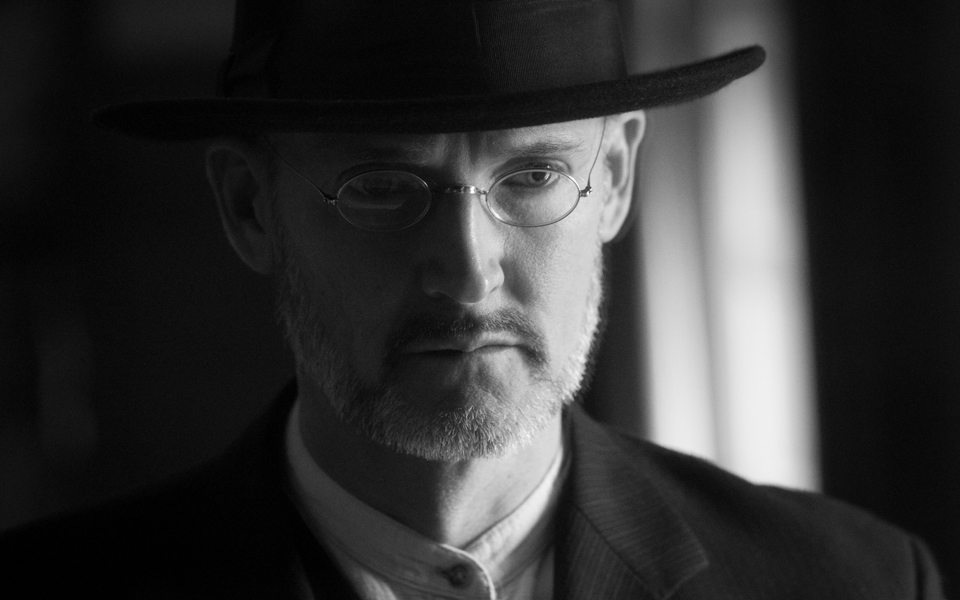
This month I've worked hard to finish off an audio-visual project that's been part of my life for the last year. At the festival where it was aired for the first time it won two prizes, and I do like to win prizes, but what actually meant more to me was the number of people who commented on the emotions it inspired. [If you'd like to watch it, click here to see it on Vimeo.]
The idea sprang from a photoshoot that J and I did on the beach at New Smyrna, Florida. I had invented a character called Matthew Loney who had left his home in Kilcloud, County Down, in tragic circumstances and sailed to a new life in America. Matthew, in his Irish linen shirt, black hat and dark trousers is seen walking on a pale, sandy beach with a book in his hand.
There was an appealingly atmospheric quality to the photographs from this shoot, and they made me think that perhaps there was a bigger story here that could be developed.
On his next visit here, the ever-co-operative J gamely dressed in Matthew Loney's full Irish suit for some shots at the Ulster Folk Museum, one of the few places in which walking round in a turn-of-the-century hat and waistcoat looks perfectly normal. And in the same week a quick change in the car by Minerstown Beach led to some nice images with the Mournes in the background.
With an overall structure in place - a bereavement leading to emigration from Ireland to America - I began to invent details. I added the idea of the ring, first seen on Sophia's finger during the happy start of the story, later thrown down in despair by Matthew on the County Down beach, and finally found again, magically, in Florida. I used a cast silver heart ring that I'd made myself - it's not at all historically accurate, but I liked the fact that it was handmade and my own.
I decided that Sophia would play the harp, drawing attention to her fingers, and hence the ring, and allowing me to use a harp as a key part of the score.
Daffodils appeared in the teaching charts behind Matthew in his school, giving me the idea that he would pick one as he walked happily home from work, and that this would later be shown, withered and decayed, as Sophia died.
Sophia's face is never seen, except in the photograph Matthew packs. Her hand is, and it's my own hand here, shot sometimes with a remote and sometimes by a trusty assistant - many thanks to J and to Hope for helping with this.
I used the AV software PicturestoExe to organise my photographs into groups, like scenes in a play: Matthew teaching in his school, Matthew walking home, domestic details and so on.
It took several weeks to compose and record the music. I began by creating little melodic motifs for both Matthew and Sophia. These are settings of their names (D E G F# for Matthew and B A D for Sophia), designed so that the motifs would fit together in harmony when needed - you can hear them together in the "love" scene and in the final beach scene.
Then I created short complete pieces for both Matthew and Sophia. Matthew's is played at the very start. Sophia's is heard when we first see their house.
For the sadder scenes, I developed the motifs and melodies to incorporate different modes, more dissonant harmonies and altered rhythms, as well as moving into different keys to create a satisfying overall structure.
It took many hours then to sequence the photographs, edit the music to fit, and create transitions appropriate to each scene.
I'm pleased with the final product - but of course I can already see things that I'd like to change.... In some ways I hate messing round again with work that I've thought of as finished, but I think some further editing may help. For instance, it wasn't clear to all the viewers that Sophia had actually died, and since that's a vital part of the narrative, I'll revisit this scene and try to make it more unambiguous.
But then I need to start work on a new project. Some ideas, black and white and a little shadowy, are already spinning round in my mind.
Nana doesn't recognise me any more. She's been like this for months now. She's looking at me with bland politeness, wondering who I am.
It fascinates me a little bit. How can that happen? Is it like one day when you're really old you just can't be bothered to hold that web of knowledge and experience and love together in your head any more? Whoosh, you let it all go, and you're left happy and empty like Nana is now?
But mainly it slashes at my soul. Nana was all I had.
We sit quietly.
She's smiling now. I'm trying to, but it's hard. Ellen's mum helped me look round the nursing homes to choose the right one for Nana. I cried through every night of that week. This one was the best, but I had no idea that people had to live in places like this.
We've spent hours this way. Nana doesn't talk. Sometimes I do, but she just looks at me with that polite smile. My chat dries up sooner and sooner.
One of the nurses comes in with a little plastic medicine cup. Nana swallows down the red syrup obediently.
As the nurse leaves, her heel catches on a tin box under Nana's chair. She doesn't notice, but Nana leans forward awkwardly and tries to take hold of the box. I grab the papers that come sliding out.
They're photographs, grainy and yellowed. They're of a girl in a crazy 60s swimsuit and cap, smoking and laughing, sitting on what looks like one of the old chairs from our kitchen. She seems familiar - the hair curling at her neck, the line of her jaw.....
Nana looks straight, clear at me. My breath catches.
That's Mona, she says. You're very like her.
The light in her eyes dulls and her focus softens back to the bland smile.
I tuck the photographs into my bag and Nana's final gift into my heart.
You bought the hat on a fresh October day in the village of Goodluck, North Carolina. You thought the soft blue straw brought out the colour of your eyes. The roses were an afterthought. They were difficult to attach, but since you'd taken the trouble to dye the pale velvet petals in cold coffee, you kept trying until they were arranged at a flattering angle.
You wore it the evening you met him. You weren't to know that he thought you were pretty but itched to pull the tightly fitting flowers from your honey-coloured braid and see your smile relax.
You wore your Goodluck hat throughout your courtship, until the evening when he did pull it gently from your head and relax your smile. The jaunty blue straw cloche took up its place on a hook on the hall dresser in your new little house.
Two summers later, you bought some yellow silk flowers, thinking you'd replace the fading coffee-coloured roses. But as you started to unpick your awkward stitching, you felt a pang for your hopeful eighteen-year-old self and let them be.
Fashions changed. Brims widened, feathers replaced flowers, netting became essential. Your blue hat moved from the hall dresser to the top of your wardrobe to the attic.
You lived your long years carefully behatted. Many of your pretty favourites he still itched to snatch from your head. Some he tolerated, and a few he almost liked.
But mostly he loved to see your soft hair, as its honey became dove and then snow.
A paper found in the prayer book of the accused, Grace Hill.
I tend my flowers dutifully.
This side of the wall, they're sheltered from the chill Antrim wind. The soil is dug to a fine tilth. Rain is plentiful and sun sufficient. They flourish.
Sometimes, though, they grow too high.
They become vulnerable.
I have been watching you carefully.
Behind this linen armour I'm a dove of a girl with the eyes of a fox. I've been cherished, preserved and indulged. They cosset and dote. But I can see through the knots of the lace, my own fine work.
I see you. It does not suit me to become vulnerable.
Testimony from Annie Hedley, a friend of Miss Hill.
Grace thought she were better than us. On account of her being the doctor's daughter. Jack Moore had an understanding with our Susan, but Grace saw him that afternoon and decided he were hers.
No, Sir, Jack were not at fault. He called for our Susan as usual. Susan were anxious-like, and said to Jack that Grace had set her eye on him. Jack said to Susan that Grace's nose were too long for his tastes. He took it all in light heart.
Susan is still abed. Likely she will be for some time more. She has wore her eyes raw with weeping.
Belladonna. Grace said it meant Beautiful Lady. In a lovely bottle, it were, on her dresser.
Report from the Belfast Evening Telegraph, September 25th, 1883
Miss Grace Hill, aged seventeen years, appeared in the dock accused of the murder of Jack Moore, twenty, of Ballykennedy, County Antrim. Mr Donnelly, prosecuting, said that the prisoner had taken against Mr Moore when it appeared that he did not return her affections, and had obtained a Poison from the surgery of her Father, Doctor Hill, having read of its effects in his papers, with the intention of punishing the young gentleman.
Report from The Lancet, 1881, presented in evidence by Mr Donnelly
On September 1st
September 2
, 1881, Mrs K__ , a highly nervous patient, suffering from chronic metritis,
inadvertently swallowed from half an ounce to an ounce of belladonna liniment…I visited her at
2pm, when she was insensible, with wild, scared, and pinched features, anaemic, with lips blue
and pale, the pupils being fully dilated..pain in the pit of the stomach…frequent retching and still incoherent...
Statement of the accused, Grace Hill, on hearing the evidence presented against her
Beautiful blooms, beautiful ladies, beautiful freedom. I hold my dove head high and pure. The linen lace knots round my throat and my body passes on the sisters' path.
Grace Hill was found not guilty of murder by virtue of Lunacy but instead remanded into the custody of the local Hospital for the Insane. She remains there to this day, tending the Flowers within the Walled Garden.
I love going to events like this. Finding out about how people lived in the past is so interesting, and the old leisure centre, corners of it untouched for decades, is the perfect place to catch a glimpse of what's not there any more.
Toby loves it too. He pays careful attention to everything our tour guide says. I can tell that he's drinking in the atmosphere. He's sensitive that way. Always has been.
The guide leads us from the worn brick foyer, which was once the second class entrance, into a corridor next to the abandoned pool. This is what I've been most looking forward to seeing. I can actually feel my heart beating a bit faster. I hold tighter to Toby's hand. The woman beside me steps further away.
Our little group squeezes through the doorway and emerges into a wide, sombre space, glazed white and trembling with memories. The floor of the empty pool gleams a little, despite the dust. Toby shivers.
"Everything all right, madam?" asks the guide. I nod and smile. His frown relaxes a little.
He tells us about the pool's glory days, details as vivid as the cobalt tiles. I can almost see the swimmers in their red council-provided trunks, laughing and chasing each other, shouts echoing up to the arched windows.
We hear about the McKenna twins, who trained here as children and went on to compete for their country. About Sammy Murdock, who took forever to learn to swim but turned out to be a very successful actor. Right enough, I've seen him in a few old films.
And we hear about Sol Franklin. He was a friend of Sammy Murdock's, but he was a great swimmer, in here all the time. A kind boy, helping the younger ones, always good-natured. His mam said he was too good to be true, laughing like it was a joke, but really as proud as punch.
Until one day when he went for his evening swim and didn't come home. Everyone remembered him in the pool that night, trying yet again to teach Sammy to kick his feet out properly, pushing Tom McKenna's head under the water and getting a clout round the ear for his boldness, singing a Peggy Lee song and making everyone laugh. But they didn't remember seeing him afterwards, in the changing room or the corridor or the street.
His mam never saw him again. There was no trace of him at all. At first the streets were full of talk about him going off to meet someone or to perform in London. Betty McCavery said she'd seen him with a girl from across the town. Mad old Annie Dornan was convinced it was the fairies who took him. Everyone had a theory, but it didn't bring Sol back. Ever.
There's a moment of silence as we all think about Sol Franklin and his mam.
I wonder what's going through Toby's mind. Sometimes it's hard to tell.
The group is quieter now, and the guide gives us a few minutes to look round. I'm drawn to the pale blue door in the corner, light just visible behind it.
And to the steps, down into the water that's long drained away.
The way things do when they're too good to be true.
We leave the pool by a different door and are ambushed by a Brownie pack armed with lemon drizzle cake and cups of tea. I take a plate for myself and a plate for Toby. I set his plate on the window ledge and look at it for a long moment.
The rest of the group has moved away, but our guide comes across to me.
"You enjoyed that? I was a bit concerned about you."
"Yes, fantastic! No, really, I'm fine."
"Sad story, that, about the lost boy, eh?"
The lost boys. Sol, and Toby.
The echoes impale my heart.
"Sorry, if you'll excuse me..."
I abandon my cake plate, and Toby's, push through the Brownies and the group members and out into the street. It's cold outside.
I unchain my bike from the railings and pedal fast down the avenue.
Bokeh: points of light, rendered blurry by a lens. Or by memory.
Until, today, they all come rushing back into focus.
Your mums walk you together to your first day at primary school. You feel important in your check dresses. You both have swishy ponytails, like real ponies. Mrs McManus, your teacher, is waiting at the classroom door. Lara runs up to her and makes her laugh.
You sit at a table with Ellen and Grace. Four solemn faces. A plastic pot with four fat pencils. Four big pieces of paper, blank, ready for you to draw whatever you like. This is going to be perfect.
Ciaran moves into the estate when you're nine. His dad has a fishing boat, like your dad, and sometimes you talk to him down at the harbour. One day he shows you a black and yellow crab his dad caught. You squeal a bit, but really you think it's quite interesting. Ciaran can tell. He gives it to you to keep.
Lara likes it when you wear the same clothes. Or, even better, mix and match versions of the same clothes. Like when you wear jeans and a pink t-shirt, and she wears pink jeans with a blue t-shirt. Yours are from the factory shop, but she says hardly anyone can tell.
Ciaran asks if you want to go to the cinema in Newtownards with him. His face is all red, even though he is quite tanned and has a lot of freckles. You have to ask your mum, because of lifts, and she dithers a bit. You're very young, she says. But she likes Ciaran, and you're allowed to go.
You talk to Ciaran all the time at home, but this is weird at first. He doesn't seem like his normal self.
The film turns out to be really frightening, though, and after you let out a scream and he laughs and puts his arm round you, it's all fine. As you leave the cinema, you agree on a much less scary version of the plot that you'll both tell your parents later.
You and Lara do your homework together most week nights. She copies your French and science. She tells you that you would be so pretty if you plucked your eyebrows. She leaps up, vivid and eager, and fetches her mum's tweezers. She'll do it for you. She watches her mum do it all the time. Lara's mum is pretty, so you hold still. It hurts much more than you expected, and it looks quite patchy afterwards. Lara says it'll be gorgeous when the patches grow back in.
You and Ciaran are sitting quietly on the harbour wall. Penny for your thoughts, he says. You were thinking about nothing in particular. You turn towards him and smile. He smiles at the same time, big and bright, and holds your hand tighter.
It's Lara's idea to have a girls' picnic on the beach. Once the sandwiches and cans are done, you end up lying like four sardines on her granny's rug, sharing secrets and staring out eastwards.
Sharing secrets is also Lara's idea. Usually you hate this, but somehow the hot hazy exam-weather afternoon and the circling gulls lull your guard down. Ellen and Grace's secrets are stupid things about lifting lipsticks from McCarthy's chemists. Yours is about Ciaran.
You talk slowly, watching a trawler on the horizon. You don't see her face.
Today fast forwards. You catch your breath from time to time, for the peonies on the pew-ends in the church. His jawline, with one tiny shaving cut. Dancing on the dock to Etta James in triple time. Your mum's smiles and her old Chanel perfume, which she keeps for good. Glasses and glasses of Moet and Chandon, like it's raining stars inside your head.
Lara and Ciaran falling, laughing, through the confetti into the turquoise Beetle and driving away from the harbour into married life, tin cans rattling like hell from the back bumper.
This is where you notice him, the first day, on the corner of Fountainville Avenue. It's his hair and his eyes, and the angle he makes with the brick wall, slouching in his navy school uniform.
Stephanie sees you noticing. She and Angela rake you the whole way up the road. This is the function of your friends: to make a complete mockery of every tentative attraction, while simultaneously providing it with plenty of oxygen for potential healthy growth. You'd do the same for them.
Three days later, by means of your extensive network of spies, you find out his name. Daniel Healy. Ds and Hs appear in a range of different scripts at the back of your maths exercise book.
You and Stephanie and Angela talk about how you'll get fake IDs and go to the Eg, and maybe Daniel and his friends will be there. Angela says she got in one night with her big sister. To be honest, you don't exactly know what a fake ID looks like. You start planning your outfit anyway.
You've worked out that Daniel lives up one of these streets, Derryvolgie or maybe Adelaide Park. One afternoon before your violin lesson, when Stephanie and Angela are at netball, you walk carefully up and down, assessing each house for evidence of the Healy family. His mum would probably have the garden really nice. His dad would be out at work now, but he'd drive home in a Volvo at six o'clock and swing his little sisters round and round when they run out to meet him.
On Saturday at orchestra, Aoife Curry tells you that Daniel doesn't live on the Lisburn Road at all. That's his friend Mark. Daniel lives in the Holy Land, with his mum and Anna and Nicky. His dad doesn't drive a Volvo or swing anyone round. He was killed four years ago in an accident on the M1.
Also, she says, Daniel just started going out with Jennifer Thompson, who has naturally blonde hair and grade eight French horn. Everybody knows that brass players are the best kissers, but you hadn't thought until now about it being girls too.
You think about all this a lot, with a permanent cramp in your stomach. You're quieter even than usual. Stephanie and Angela tell you he was never worth it and exchange glances as you try to casually brush away a tear that you didn't mean to cry.
Later that summer, though, you decide that Stephanie's stupid next door neighbour Michael has improved quite a lot now that he is taller, and you start casually hanging out in her back garden in your newly cut-off Levis. It's hard to build up much of a tan when your family holiday is at your granny's in Aberdeen, but at least your legs are long and thin. Longer and thinner, you can't help thinking, than Jennifer Thompson's.
.
.
.
You're home from Bristol for the summer and your mum paid for you to get your hair done "properly, for a change". Afterwards, since it's a gorgeous day, you buy yourself a Polly Pineapple and sit in Cranmore Park for a while.
He sits down at the other end of the bench.
He's at Glasgow doing English and Philosophy. He has one more year to go. He's on his way from Mark's house to his evening bar job. It's weird being home for him too. He keeps in touch with Mark, of course, but that's really all. Anna and Nicky are in sixth form now and a bit wild. He's trying to keep an eye on them but they just laugh at him. It's great to see you. You must meet up over the summer.
The strange thing is that this is actually the first time he's spoken to you. Doesn't he know this? It was like he knew you already.
You don't meet up over the summer.
.
.
.
After the wedding, Stephanie and Michael move into a house at the bottom of Larkstone Street. It's right beside the railway tracks, but you get used to the noise after a while.
You visit them every time you're home. That's what you call it when you're talking to them, though Belfast doesn't feel like home any more. You sit on their sofa, drinking the red wine Mike chose specially for you, and a flash of pity catches you. Your own life feels bigger than Larkstone Street.
.
.
.
Steph and Mike's party is tonight. Your heart isn't really in it. Redundancy doesn't feel like a great chance to reinvent your life just the way you want it. It catches you in the stomach, the way grief always does. It makes you feel like hiding in your parents' spare room, like the useless thing you are now.
But when your mum, who is possibly wiser than you think, suggests a nice evening helping her clear out the attic, you put on some black eyeliner and an outfit that doesn't reek of self-pity and get your dad to drop you on the Lisburn Road. He quite likes being your chauffeur these days.
Steph looks gorgeous. She has been loyal over the last couple of weeks, trying hard to lift your spirits, collaborating with your mum and dad. She's glad you're here. You're glad of your eyeliner. And you're glad you came too. The party is mellow. You only know a few people, but it's Belfast, and even the people you don't know know someone you do. Your stomach begins to unclench.
The doorbell rings again. It's Mark, Steph says, and that friend of his from school.
.
.
.
You've rented a house in Melrose Street. The landlord allowed you to strip the living room walls back to the brick. It's going to look fantastic.
You're up a ladder, trying to position the Velcro strip of your Roman blind, when you notice it. The angle, as he slouches in his navy t-shirt against the wall, beside you.