Saturday, 7 November 2015
Long distance
I spent last Friday evening here on the shore at New Smyrna Beach, on Central Florida's Atlantic coast. It was the last night of my holiday, and we've learned through long experience to do something lovely and enjoyable at this point, rather than just packing and feeling sad.
Though I've packed and felt sad plenty of times. I've been in this long distance relationship for so many years that it just feels normal now, but it still never gets easier to leave. It's bad being the one walking through security at the airport to fly away. It's bad to be the one left waving goodbye. I am quite an expert on waterproof mascaras.
I'm writing this lying on the sofa in the living room of the house where I live on my own most of the time. The time difference means that J is still at work, so we can't speak on the phone. When I go out at the weekend, I go on my own and return on my own. When I get my hair done on Saturday morning, no-one will admire how pretty it is. (Though that may not be a complaint unique to people in long distance relationships.) I pay my own bills. I put out my own bins. I particularly don't enjoy the bins.
And yet....
When we are together, we are much nicer to each other than most couples I know. It's a thrill every time we meet at the airport. We appreciate each other's company. We're slow to argue because it's wasting our best time, and when we do disagree, we sort it out quickly. We take nothing for granted.
And there are benefits to time on our own as well. J rarely sees my cross, stressed, just-home-from-work face or hears me address him like a teenage pupil, which could happen all too easily. He's messy and I'm kind of average, so we keep our own spaces how we like them. Technology makes it easy to communicate through the day. We send photographs of ordinary things to stay connected. I've learned to position the computer to get the most flattering Skype angle for my cross stressed face.
You can't be needy in this sort of relationship. You have to be independent, self-reliant and patient, happy to do your own thing. You mustn't fall into the trap of counting the days till the next trip - treasure the days together when they happen instead.
Maybe everyone thinks I have an imaginary friend, and occasionally it feels a bit like that. But most of the time I'm thankful for what we have, happily looking forward to the next meeting and enjoying my life in the mean time. Also thinking that I might soon have enough air miles to upgrade to a higher class on a transatlantic flight...
Thursday, 29 October 2015
Matthew Loney in his New World
A new World it is.
A Slate, my self, washed clean.
My Journy, under-taken dazed, near forgot.
A Blessing, that, with
Part the 1st
A haze of roiling Waves &
Constant Unstediness &
Griping pain &
Part the 2nd
A Misery
By Carriage &
By Cart &
By my own nummed Feet.
Yet here at new Smyrna
One foot in Sea and one on Shore
I feel Awake again.
I look East.
Kilcloud a tiny Speck
Imagined in the distance
Thru the power of my Wishes
& yet not.
Not.
For Sophia.
For Sophia’s Shell
Is cradled by the Sand there
Dandled by the sea Creatures.
Selkies ring her Knell.
Another Slate to wash.
I read my Book.
I keep my Secret.Sunday, 18 October 2015
St Malachy's ceiling
I feel quite an affection for St Malachy. He was the first native-born Irish saint to be canonised (though plenty followed him: I found a list of 331 Irish saints at Catholic Online).
Many of his achievements were in what we might now call ecclesiastical management. But he also had the lovely idea of planting apple trees throughout the country when famine threatened during the twelfth century. Healing miracles were ascribed to him. He enjoyed travelling, including across Europe. I think he'd be a welcome guest in anyone's living room.
Here in Belfast it made sense to build a beautiful church in his name, and a foundation stone was laid in 1841, on 3 November, his official feast day. It was intended that this would be the Cathedral Church of Down and Connor. But just around then the Irish famine took hold. Funds which were due to be spent on making the church the biggest and most glorious ever were diverted to assist the starving. St Malachy would have understood and approved.
The church
that resulted, though, is still an amazing sight. It's most famous for its
superb fan vaulted ceiling. CEB Brett, my favourite author on Belfast
architecture, compares it to a wedding cake. It's unclear whether he intends this as a compliment.
St Malachy's narrowly avoided destruction during the Blitz of
1941, though many of the windows were shattered. This damage, as well as
changes in the Markets area in which it's situated, caused gradual
deterioration, and it was recently closed for over a year for restoration.
It's beautiful again now - pristine, Gothic, lacy, yet
accessible. I suspect that St Malachy might raise an eyebrow, but would stride to the
pulpit, eating an apple, to exhort us all to be kinder to the poor.
Thursday, 8 October 2015
The Women of Kilcloud at their Windows
Kilcloud, County Down. October 1875.
Counterpane, eiderdown, bed-curtain, blanket,
Simmet, stock, shift, chemise,
Ankle, calf, knee, thigh.
Soot, dust, ash, rust.
Jane Kennedy, aged 44 years
How does light enter the house?
Through these six dulled panes and glinting, a little, from my pots.
Why does light enter the house?
To pierce me, rock me, shock, entice me, beckon me forth to dance, prance, fierce and reckless and feckless.
I will not go.
Eliza Gallagher, aged 58 years
They bow their heads, but the Holy Spirit is at this present moment a diving dust-mote in the sunbeam.
I will lift my eyes.
Rebecca Doherty, aged 24 years
Framing, as best I can in ink and secret,
My Thoughts and some small Images.
This Bird, this garden Wall,
The Orchard trees beyond.
My Self, perched quietly behind the Glass.
Matilda Murray, aged 36 years
Perchance & Perhaps & I may not.
But watch me, I Wink.
Sophia Lynch, aged 16 years
She was always a great lover of flowers.
And I...
I cannot say more,
For the women of Kilcloud are always at their windows.
Annie Walsh, aged 49 years
Saturday, 3 October 2015
Crab's eye view
It's not that the seaside is tame - one of the things that scared me most was when I once walked at midnight on a pitch black beach on Florida's Atlantic coast. The sea and the sky were so dark they seemed empty. It was ridiculously and illogically frightening.
But this sort of beach, Kearney, on the Ards Peninsula, on a sunny afternoon in late September, is the opposite. It was so light and joyous that I lay on my back on the uncomfortable stones and just felt happy.
I hope you enjoy my pale, grainy crab's eye views of the unassuming sea plants which surrounded me, and others from my afternoon's wandering.
Saturday, 26 September 2015
The baths
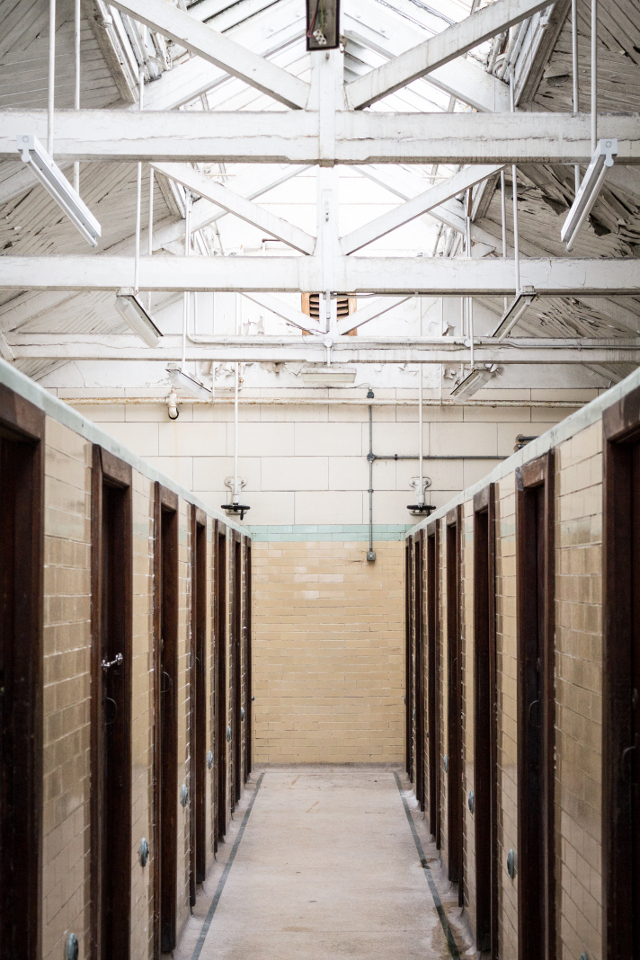
Templemore Avenue Public Baths, built in 1893. Where my primary school class went to swim in the mid-70s.
What I remember.... a shivery, worried anticipation, cold, fear. My friends Stephanie and Joanne could swim much better than me. I didn't want to attract the teacher's attention. I tried hard. But I didn't come from the sort of family where we'd go to swimming baths regularly, where perhaps I'd be coached in special strokes and would "train". Instead, we had swum on random County Down beaches, teeth-chatteringly cold, where the best bit was racing up and down the sand afterwards, protesting and obeying Mum's instructions to keep warm by not giving in and shivering. Templemore was a different sort of swimming.
What I see now.... a sweet and shy child, grateful for the individual changing cubicles, where you could always delay just a little longer. Probably, a slightly ill-fitting swimming costume revealing stick-thin limbs that could maybe have been sporty but never quite were. A quite uncaring teacher, with little patience for children who couldn't do this all already.
And now, in the baths as in some other places I pass every week, I like to imagine my adult self beside the skinny nine-year-old, encouraging her, praising her efforts and holding her up when she started to sink. That would have been enough.
As well, it would have distracted that little girl nicely to know about the other side of the baths, behind the life-belt wall. In the next room were the actual baths, where people went to wash.
Belfast was a dirty city, generating grime in the linen mills and shipyards, and a poor one. Houses in this part of the city didn't have bathrooms, and in the earlier years of the century, you came to the public baths instead.
A whole family could make use of one rented cubicle. You were given six inches of hot water, yours to cool and augment with cold. I like to think the children bathed first and grubby Harland and Wolff welder father last, but that might be overoptimistic. You rented a towel and borrowed a cake of soap.
People sang in their bathrooms. There's a great echo. You returned your soap, the towel was laundered in a gigantic basement washing machine, and you stepped back out into the East Belfast evening.
I'd love to have known that. At nine, nose rarely out of a book, I was fascinated by what I'd eventually come to know was social history. I already had a sense of the ghosts that moved around old buildings with their scents and their snatches of song. Here, on the white Victorian tiles, how much more important it would have been to hear Letty Moore from a 1930s McMaster Street singing in the tub, than to listen to vain Miss P's sharp swimming stroke strictures.
Subscribe to:
Posts (Atom)